
Utah DLD Permit Practice Test 6
Test 6 of 10. Pick an answer for each question to see if it is right and why; your score appears at the end. You need 40 correct answers to pass, the same ratio as the real Utah test.
- Questions50
- Correct to pass40
- Passing score80%
- Minimum age15 years
-
1. The crossbuck, formed by two rectangular arms crossed in an X, is placed
Show answer
Answer D: on each highway approach to a railroad grade crossing
The crossbuck marks the location of a highway-rail grade crossing and is required on each highway approach to that crossing.
-
2. What is the best way to keep your phone from distracting you on a trip?
Show answer
Answer D: Silence it and stow it before you start
A phone you cannot hear and cannot reach cannot tempt you, which is far more reliable than deciding case by case while you drive.
-
3. You are turning left from a one-way street onto another one-way street. Which lane should you use?
Show answer
Answer B: Turn from the far left lane into the far left lane of the new street
The general turning rule is to turn from the lane nearest the direction of the turn into the nearest lane of the new roadway, which on a one-way to one-way left turn means far left to far left.
-
4. Why is heavy braking a poor idea while two wheels are still on a soft shoulder?
Show answer
Answer B: The two sides have different grip, so the vehicle can pull sharply
With one pair of wheels on pavement and the other on loose material, hard braking slows one side more than the other and swings the vehicle around.
-
5. What point value does Utah assign to an improper passing conviction?
Show answer
Answer D: 50 points
Improper passing is worth 50 points on the Utah schedule, matching careless driving and impeding traffic.
-
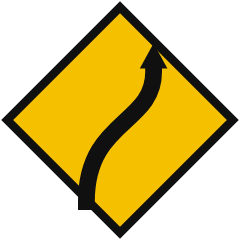
6. A driver holds a steady highway speed into the section this sign warns about. What is the most likely result?
Show answer
Answer B: The vehicle runs wide toward the outside and can cross into another lane or leave the pavement
Holding speed into a change of alignment asks the tires for more side grip than they can supply, so the vehicle runs wide and the driver is left with less room to correct.
-
7. The light ahead is green, but traffic beyond the intersection is backed up so far that you could not clear it. What is the correct action?
Show answer
Answer D: Wait behind the stop line until there is room on the far side
Entering an intersection you cannot clear blocks cross traffic and pedestrians, so you should hold your position until space opens on the other side.
-
8. A sign at the signal reads LEFT TURN ON GREEN ARROW ONLY. The ball turns green but no arrow appears. What may you do?
Show answer
Answer C: Wait, because your turn is allowed only while the arrow is showing
The sign removes the permissive turn, so the left is legal only during the green arrow and you must wait behind the line until it appears.
-
9. You are waiting in a left-turn lane at a green light when a fire engine with lights and siren comes toward you in the oncoming lanes. What should you do?
Show answer
Answer D: Hold your position and let the fire engine pass
Turning across the path of an approaching emergency vehicle is exactly what you must not do; stay put until it has gone by.
-
10. You are about to pass a long tractor-trailer on a two-lane road. What should you expect?
Show answer
Answer B: You will need more clear road, since the vehicle is much longer
A tractor-trailer can be 70 feet long, so passing it takes more distance and more time than passing a car at the same speed difference.
-
11. What is a good rule for any task you want to do inside the vehicle?
Show answer
Answer D: If it needs more than a moment, do it stopped
A glance of a second or two is manageable, but any task that runs longer belongs to a stopped vehicle, because the road does not pause while you do it.
-
12. You have turned right into the nearest lane but you need the left lane soon. When should you move over?
Show answer
Answer A: After the turn is finished, once you have checked mirrors and blind spot
Complete the turn in the proper lane first, then make a normal lane change with mirror and blind spot checks once you are established on the new street.
-
13. The traffic around you is moving well above the limit on a wide highway. What should you do?
Show answer
Answer D: Keep to the limit and stay to the right, letting faster traffic pass
The limit is a legal maximum, and the safe way to differ from the traffic around you is to keep right and let it go by.
-
14. A sign beside the signal reads STOP HERE ON RED. What does it tell you?
Show answer
Answer B: Stop at that point on red, not closer to the intersection
The sign marks the required stopping point, which is set back from the corner so that turning vehicles and sight lines are not blocked.
-
15. A Utah driver under 21 accumulates 70 or more points within three years. What suspension range does the Driver Improvement hearing authorize?
Show answer
Answer A: 30 days to 1 year
Reaching the 70 point threshold exposes a driver under 21 to a suspension or denial ranging from 30 days to one year, decided at the hearing.
-
16. You approach a one-lane bridge and there is a yield sign facing your side of it. What does that mean?
Show answer
Answer B: Oncoming traffic crosses the bridge first and you wait at the approach
At a one-lane bridge the yield sign tells one direction to give way, so you wait clear of the bridge until oncoming traffic has crossed.
-
17. A flashing red arrow is displayed for your turning lane. What does it require?
Show answer
Answer D: Stopping, then turning when the way is clear
A flashing red arrow is treated like a stop sign for that movement: come to a full stop, then turn when it is safe and no one has to be cut off.
-
18. You find that your shoulder belt has some slack in it. Why does that matter?
Show answer
Answer D: You travel further before the belt restrains you, so injuries are worse
Slack lets your body build up speed before the belt takes hold, which increases the forces on you and the risk of hitting the interior.
-
19. The lane control signal above your lane changes to a steady yellow X. What should you do?
Show answer
Answer A: Prepare to leave the lane, because it is about to be closed
A steady yellow X is the warning that the lane below it is about to close, giving drivers time to move over before the red X appears.
-
20. You are turning left from a two-way street onto another two-way street. Where should you begin and end the turn?
Show answer
Answer B: Begin in the lane just right of the center line and finish just right of the center line of the new street
You approach a left turn from the lane closest to the center line and enter the new roadway just to the right of its center line, which keeps you clear of oncoming traffic.
-
21. What must a Utah learner permit applicant provide, beyond passing the required tests?
Show answer
Answer D: Proof of identity, lawful presence if a non-citizen, a Social Security number, and a Utah address
Utah requires a learner permit applicant to document identity, lawful presence for a non-citizen, a Social Security number, and a Utah address.
-
22. What does a first conviction for illegally passing a stopped school bus cost a Utah driver, beyond any points?
Show answer
Answer C: A fine of up to 1,000 dollars and 10 hours of community service
Utah punishes a first conviction for passing a stopped school bus with a fine of up to 1,000 dollars plus 10 hours of community service.
-
23. How does Utah classify a texting while driving conviction?
Show answer
Answer A: A class C misdemeanor with a maximum fine of 100 dollars, rising to a class B misdemeanor with bodily injury or a prior offense
Utah treats texting while driving as a class C misdemeanor with a maximum 100 dollar fine, and upgrades it to a class B misdemeanor if bodily injury results or the driver has a prior conviction for the same offense.
-
24. How long must a Utah driver convicted of a first driving under the influence offense use an ignition interlock device?
Show answer
Answer C: 18 months, or three years if the driver was under 21 at arrest
A first conviction brings an automatic interlock restriction of 18 months from conviction or from the suspension date, extended to three years when the driver was under 21 at the time of arrest.
-
25. Where no other limit is posted and the location is not an urban district, what speed does Utah statute treat as lawful?
Show answer
Answer C: 55 mph
Outside urban districts, Utah's default statutory speed where nothing else is posted is 55 mph.
-
26. How should you follow a school bus in traffic?
Show answer
Answer A: Far enough back to see its lights and stop in time
A school bus stops often and with little warning, so a longer following distance gives you time to see the lights come on and stop clear of it.
-
27. When should most of your braking for a turn be finished?
Show answer
Answer B: Before you begin to turn the wheel
Slow to the right speed before the turn begins; braking hard while turning uses up the grip the tires need for steering.
-
28. What is the minimum age to take the driving skills test in Utah?
Show answer
Answer B: 16 at a Division office and 15 with a third party tester or a high school program
The Driver License Division tests applicants from age 16, while a third party tester or a high school program may test from age 15.
-
29. The driver ahead of you is straddling the lane line and is not signaling. How should you respond?
Show answer
Answer B: Stay back until you can see which lane that driver will take
A vehicle astride the line could move either way, so the only safe place is behind it where both possibilities are still covered.
-
30. A yellow diamond shows a horse with a rider. Besides slowing down, what else should a driver do?
Show answer
Answer C: Avoid using the horn or revving the engine
The equestrian crossing sign warns of horses on or across the road, and a sudden noise can startle an animal into the traffic lane.
-
31. What color scheme does a standard stop sign use?
Show answer
Answer B: White legend and border on a red background
The stop sign carries a white legend and border on a red background, the color set aside for stop, yield and prohibition messages.
-
32. What is the most common cause of rear-end collisions?
Show answer
Answer C: Following too closely to stop in time
A driver who leaves too little space has no room to perceive, react and brake when the vehicle ahead slows, which is why space management prevents rear-end crashes.
-
33. A bike lane on your right is marked with a dashed line for the last stretch before the corner. What does that dashed section allow you to do?
Show answer
Answer D: Merge into the bike lane after checking, and turn right from there
The dashed section is where drivers are meant to merge into the bike lane before turning, which puts cyclists behind the vehicle instead of beside it.
-
34. A broken white line separates your lane from the lane on your right. What does it permit?
Show answer
Answer C: Changing lanes when it is safe to do so
A normal broken white line marks a boundary between lanes traveling the same way that road users may cross when it is safe.
-
35. A stop line is painted across the pavement at this sign. Where must the vehicle come to rest?

Show answer
Answer A: Behind the stop line, with no part of the vehicle across it
The vehicle must halt behind the stop line; where no line is painted the driver stops before the crosswalk, and where there is neither, before entering the intersection.
-
36. How long does a DUI or drug related charge stay on a Utah driving record?
Show answer
Answer D: 10 years
Utah keeps a DUI or drug related charge visible on a driving record for 10 years, far longer than the standard retention window.
-
37. How much more energy must your brakes absorb if you double your speed?
Show answer
Answer D: About four times as much, since energy rises with the square of speed
Kinetic energy grows with the square of speed, so twice the speed means about four times the energy and a far longer braking distance.
-
38. A truck passes you in heavy rain and its spray blanks out your windshield. What should you do?
Show answer
Answer B: Hold the wheel steady, ease off slightly and let the wipers clear it
The blackout lasts a second or two. Keeping your line and easing off is far safer than braking hard or steering blind toward the shoulder.
-
39. What is meant by keeping a space cushion?
Show answer
Answer C: Keeping open space on all sides of your vehicle so you always have somewhere to go
Open space ahead, behind and to the sides gives you time to react and an escape path when a hazard appears, which is the core idea of defensive driving.
-
40. After a Utah DUI arrest, how many days does the driver have to request a Driver License Division hearing to contest the administrative license action?
Show answer
Answer A: 10 days
A driver arrested for DUI in Utah must request a Driver License Division hearing within 10 days to contest the administrative suspension process.
-
41. A person with a guide dog is standing at the corner facing the street you are about to cross. What should you do?
Show answer
Answer D: Stop well back and wait quietly for them to decide
Blind pedestrians rely on engine sound to judge traffic, so stop back from the crossing and avoid the horn, which only confuses them.
-
42. Two vehicles meet on a steep, narrow mountain road with no room to pass. Which driver should back up?
Show answer
Answer C: The driver heading downhill, who has more control while reversing
On a narrow mountain road the vehicle facing downhill yields, because backing uphill gives better control than reversing down a grade.
-
43. What is a designated driver?
Show answer
Answer A: Someone who agrees to drink nothing at all
A designated driver drinks no alcohol whatsoever, because any amount begins to affect judgment and the whole point is a sober driver.
-
44. You notice at night that one of your headlights has burned out. What should you do?
Show answer
Answer B: Get it replaced promptly, because other drivers may take you for a motorcycle
A single light makes your vehicle look narrower and further away, so other drivers misjudge you, and one light is also illegal.
-
45. Utah law limits how far ahead the high intensity part of a headlight beam may strike the roadway. What is that limit?
Show answer
Answer C: 75 feet
Utah requires that the high intensity portion of a headlamp beam not strike the roadway at a distance of more than 75 feet ahead of the vehicle, limiting glare to oncoming drivers.
-
46. You are approaching an uncontrolled intersection on a residential street where parked cars hide the cross street. What is the correct approach?
Show answer
Answer B: Slow enough to stop and creep out until you can see
Without a sign or signal you still have to be able to yield, and you cannot yield to traffic you have not seen.
-
47. Starting May 7, 2025, what does a REAL ID compliant Utah credential allow that a non-compliant one does not?
Show answer
Answer A: Boarding a domestic commercial flight or entering certain federal facilities
Since May 7, 2025, a REAL ID compliant credential has been required to board a domestic flight or enter certain federal facilities in Utah as elsewhere.
-
48. You have strapped luggage to the roof rack for a long trip. What should you expect?
Show answer
Answer D: A higher center of gravity, so take the curves and lane changes gently
Weight on the roof raises the center of gravity and makes the vehicle lean and respond more slowly to steering.
-
49. The brake warning light stays on even though the parking brake is fully released. What does it indicate?
Show answer
Answer B: A possible brake system problem, so have the brakes checked promptly
The brake warning light also signals low brake fluid or a failure in one part of the hydraulic system. Do not ignore it, because braking may be reduced.
-
50. You have just returned to your own lane after passing. Why should you not slow down straight away?
Show answer
Answer A: The vehicle you passed is close behind and needs room to stop
Returning and then braking leaves the driver you just overtook with almost no following distance, which is how a pass turns into a rear-end collision.