
Utah DLD Motorcycle Practice Test 54
- Questions25
- Correct to pass20
- Passing score80%
- Minimum age16 years
-
1. A driver has to stop for a train at this sign. How far back from the nearest rail should the vehicle be held?

Show answer
Answer C: No closer than roughly fifteen feet
A train and its load overhang the rails, so stopping no closer than about fifteen feet keeps the vehicle outside the space the train actually sweeps.
-
2. Your lane is ending ahead in slow, heavy traffic and drivers in the next lane are already bumper to bumper. What is the recommended way to merge?
Show answer
Answer C: Take turns, one vehicle from each lane at the merge point
Alternating one for one at the merge point keeps both lanes moving and is the safest way to combine slow traffic.
-
3. If you must abandon a vehicle stuck on the tracks with a train coming, why do you move toward the train and away at an angle?
Show answer
Answer D: Because debris from the impact is thrown forward, away from the train
A train pushes wreckage down the track ahead of it, so walking toward the train and off to the side keeps you out of the debris path.
-
4. For Utah's doubled work zone speeding fine to apply, what must be true of the site?
Show answer
Answer A: It must be clearly marked with signs warning that fines are doubled there
The doubled fine only attaches where the highway construction or maintenance site is clearly marked with signs warning drivers that fines are doubled.
-
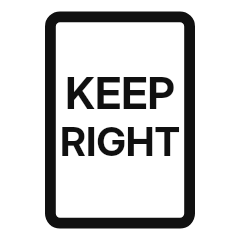
5. Where is this sign normally installed?
Show answer
Answer A: At an island or other obstruction in the roadway, to show which side traffic must take
It is placed at a divider, island or fixed obstruction so that drivers approaching it know without hesitating which side to pass on.
-
6. A large X with the letters R and R beside it is painted across your lane. What does it mean?
Show answer
Answer A: A railroad crossing lies a short distance ahead
The pavement marking repeats the advance warning for a grade crossing, and it is used on paved approaches where speeds are high or where gates are installed.
-
7. How should a rider use a motorcycle fitted with antilock brakes in an emergency stop?
Show answer
Answer D: Apply firm, steady pressure to both brakes and keep it there
An antilock system releases and reapplies pressure far faster than a rider can, but only while the rider keeps holding the brakes on.
-
8. The overhead signal above your lane changes to a steady yellow X. What should you do?
Show answer
Answer B: Prepare to move out of that lane
A steady yellow X warns that the lane is about to close, so drivers should get ready to vacate it in favor of an open lane.
-
9. A sign reads MINIMUM SPEED 40. What does it require of a driver?
Show answer
Answer C: Not to drive below that speed when conditions allow
A minimum speed limit keeps unnecessarily slow vehicles from obstructing traffic, but it never overrides the duty to slow down for weather or congestion.
-
10. What is the main source of the noise that damages a rider's hearing?
Show answer
Answer A: Wind turbulence around the helmet, which rises sharply with speed
Wind noise around a helmet is loud enough at highway speed to cause permanent hearing loss over time, which is why earplugs are recommended even on quiet machines.
-
11. Some drivers believe they can multitask while driving. What does research show?
Show answer
Answer C: The brain switches rapidly between tasks and driving performance suffers
The brain does not truly do two attention-demanding tasks at once; it alternates between them, and the driving task gets less attention each time.
-
12. What is the benefit of looking far down the road rather than just ahead of the hood?
Show answer
Answer A: You steer with smaller corrections and you see trouble in plenty of time
A distant view steadies your steering and gives you time to plan, because you meet hazards after you have already seen them.
-
13. You are approaching a blind left hand curve. Which starting lane position gives the best view through it?
Show answer
Answer C: The right portion of your lane
On a left hand bend the outside of the lane is the right side, and moving there lets the rider see farther around the curve before entering it.
-
14. Your motorcycle starts to wander while you ride over rain grooves or a bridge grating. What should you do?
Show answer
Answer A: Relax, hold a steady speed and ride straight across
The wandering feeling on grooved surfaces and gratings is unsettling but generally not hazardous, while zigzagging to fight it is far more dangerous.
-
15. Why is an inexperienced rider a poor choice to lead a group?
Show answer
Answer C: The leader picks the pace, the gaps and the hazards for everyone behind
Every decision the leader makes is imposed on the riders behind, so leading demands more traffic judgment than any other position in the group.
-
16. A sign showing a figure with an outstretched thumb inside a red circle with a slash means that
Show answer
Answer B: soliciting a ride is prohibited there
The no hitchhiking sign bars standing beside the road to solicit a ride, and it is common along freeway ramps and shoulders.
-
17. Without a depth gauge, how can a rider tell that a tire has worn out?
Show answer
Answer A: The tread has worn down level with the wear bars set into the grooves
Wear bars are molded across the bottom of the tread grooves, and once the tread surface reaches them the tire has no usable depth left.
-
18. How should a group plan its rest stops on a long day?
Show answer
Answer A: Around the rider who tires first, with breaks before anyone is worn out
Fatigue destroys judgment long before a rider admits to it, so the break schedule follows the least rested rider rather than the strongest one.
-
19. What is the function of a regulatory sign?
Show answer
Answer A: To inform road users of traffic laws or regulations that apply at that location
Regulatory signs state requirements that carry the force of law where they are posted, so disregarding one is a violation rather than a lapse of judgment.
-
20. You are stopped in a shared through and right-turn lane with your right signal on, and a bicyclist rides up along your right side. What should you do?
Show answer
Answer A: Let the bicyclist clear the intersection or move ahead before you turn
A cyclist alongside your right side is in the path your turn will sweep across, so wait until that space is clear before turning.
-
21. What is the main danger of grabbing the front brake lever abruptly?
Show answer
Answer D: The front wheel can lock, and a locked wheel cannot steer or balance
The front brake must be squeezed progressively so that weight transfers onto the front tire before full braking force is asked of it.
-
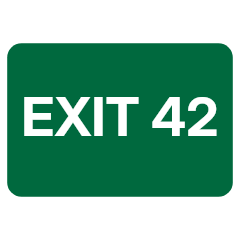
22. A driver in the left lane of a freeway realizes only when level with this sign that the ramp beside it is the one they need. What is the correct action?
Show answer
Answer A: Carry on to the next interchange and turn back from there
There is no safe way back to a ramp once it has been reached from the wrong lane, so the driver keeps going to the next interchange, where the ramps are built for that movement.
-
23. A yellow diamond in which one line joins another at an angle warns that
Show answer
Answer B: traffic from another roadway will merge into the driver's lane ahead
The merge sign warns that another traffic stream will join the same lane ahead, so drivers on both roadways must adjust speed and spacing.
-
24. A tow truck with flashing amber lights is loading a car on the shoulder ahead. How should you treat it?
Show answer
Answer B: Give it the same room as an emergency vehicle
Tow operators, utility crews and highway workers face the same danger from passing traffic, so move over or slow down for their flashing amber lights too.
-
25. Why is a motorcycle particularly hard for other drivers to judge at night?
Show answer
Answer A: Its single headlight gives no width cues for distance and speed
Drivers judge distance from the spacing between a pair of headlights, and a single lamp gives them nothing to measure, so they routinely misjudge how close and how fast a motorcycle is.