
Utah DLD Motorcycle Practice Test 27
- Questions25
- Correct to pass20
- Passing score80%
- Minimum age16 years
-
1. How far ahead should you normally be looking while driving?
Show answer
Answer D: About 12 to 15 seconds of travel ahead
Looking that far ahead, roughly a block in town and much farther on a highway, gives you time to see a problem developing and adjust before it becomes an emergency.
-
2. The lights at a highway-rail grade crossing begin to flash red as you approach. What must you do?
Show answer
Answer B: Stop short of the tracks and wait until the lights stop and no train is near
Flashing red lights at a crossing require a stop clear of the tracks, and you may proceed only once the lights have stopped, any gates are fully raised and no train is approaching.
-
3. What should a passenger do when the motorcycle leans into a curve?
Show answer
Answer A: Lean with the operator, staying directly behind them
A passenger who leans with the operator lets the motorcycle follow its natural line, while leaning against the lean fights the operator's control inputs.
-
4. While you swerve around an obstacle, what should the rest of your body be doing?
Show answer
Answer C: Staying upright with the knees against the tank while the motorcycle leans
A swerve happens through the handlebars, and a body that stays still and anchored to the tank lets the motorcycle move quickly beneath the rider.
-
5. You are approaching an intersection in a line of traffic. What can you do to be more visible to a driver waiting to pull out?
Show answer
Answer D: Move to a lane position where you are not hidden behind the vehicle ahead
A motorcycle tucked directly behind a larger vehicle is invisible to a waiting driver until the moment it appears, so the rider moves to where the headlight can be seen.
-
6. The lane control signal above your lane changes to a steady yellow X. What should you do?
Show answer
Answer A: Prepare to leave the lane, because it is about to be closed
A steady yellow X is the warning that the lane below it is about to close, giving drivers time to move over before the red X appears.
-
7. Your vehicle breaks down on a busy highway. What is the safest course of action?
Show answer
Answer D: Get it as far off the roadway as possible, switch on the hazard lights and keep clear of the traffic lanes
A vehicle left in or beside a travel lane is a hazard, so move it well off the road, make it conspicuous with hazard lights and keep yourself away from passing traffic.
-
8. A funeral procession with headlights on is crossing an intersection when your light turns green. What should you do?
Show answer
Answer A: Wait and let the whole procession go through
Most states let a funeral procession stay together once the lead vehicle has lawfully entered an intersection, and in every state you must yield to vehicles already in the intersection, so wait until the line has passed.
-
9. A center lane is bordered by a solid yellow line on the outside and a broken yellow line on the inside, with turn arrows painted inside it. What is that lane for?
Show answer
Answer C: Left turns made by traffic traveling in either direction
That marking pattern identifies a two-way left-turn lane, which drivers approaching from both directions may use to prepare for a left turn.
-
10. How does alcohol change the time a driver needs to respond to a hazard?
Show answer
Answer A: It slows it, so stopping takes longer
Alcohol is a depressant that lengthens the time between seeing a hazard and acting on it, which adds directly to the distance needed to stop.
-
11. On traffic control devices, the color green shows direction to a destination and also shows
Show answer
Answer C: that a movement is permitted
Green carries two assignments: guidance toward destinations, and the idea that the movement shown is allowed, as on a green arrow.
-
12. What must a motorcycle be equipped with before it can safely carry a passenger?
Show answer
Answer B: A seat large enough for two people and a set of passenger footrests
A passenger needs a seat with room for both people without crowding and firm footrests to brace against.
-
13. What is sensible when you drive in an unfamiliar town for the first time?
Show answer
Answer C: Drive a little slower and give yourself more time to read the signs
In unfamiliar surroundings you need longer to take in signs, junctions and markings, and lower speed buys that time.
-
14. Why does this warning matter more on a motorcycle than in a car?
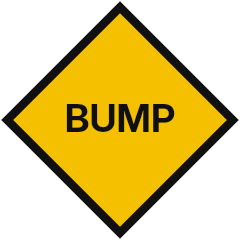
Show answer
Answer B: Because a sudden jolt can unsettle a two-wheeled machine and the rider can lose control
A jolt can push a motorcycle off line or lift a wheel, so a rider slows early, comes slightly off the seat and keeps a relaxed but firm hold on the handlebars.
-
15. What does black ice usually look like from the driver seat?
Show answer
Answer C: A patch of pavement that simply looks wet or slightly glossy
Black ice is clear, so you see the dark road through it and read it as a wet patch. In freezing weather, treat any wet looking patch as ice.
-
16. A motorcycle ahead of you is weaving slightly as it crosses a stretch of grooved pavement. What should you do?
Show answer
Answer D: Give the rider extra room until the surface improves
Grooves, metal plates and loose material affect a motorcycle far more than a car, so back off and let the rider deal with the surface.
-
17. A driver ahead of you extends the left arm straight out horizontally through the window. What is being signaled?
Show answer
Answer C: A left turn
The left arm held straight out is the standard hand signal for a left turn.
-
18. When should gear changes for a turn be completed?
Show answer
Answer A: Before entering the turn, so the machine stays settled through it
A clumsy shift while leaned over can jerk the rear wheel and break traction, so the right gear should be selected before the lean begins.
-
19. You feel fine twenty minutes after your last drink. Why is that a poor guide to driving?
Show answer
Answer B: Your blood alcohol level can still be rising
Alcohol keeps being absorbed for some time after the last drink, so a driver who feels able at the door can be more impaired a few miles down the road.
-
20. On a motorcycle with a standard shift pattern, where is neutral found?
Show answer
Answer C: Between first gear and second gear
The usual pattern is one down and the rest up, with neutral sitting half a click between first and second gear.
-
21. When should you arrange your way home if you plan to drink?
Show answer
Answer C: Before the first drink
Judgment is the first thing alcohol weakens, so the plan has to be made while you can still make a good one.
-
22. Where should a touring rider keep the rain suit?
Show answer
Answer B: Somewhere it can be reached quickly without unpacking everything
Rain gear only helps if you can get to it before you are soaked, so pack it where a quick roadside stop is enough to reach it.
-
23. The oil pressure warning light comes on while you are riding. What should you do?
Show answer
Answer D: Stop as soon as it is safe and shut the engine off
That light warns that the engine may not be receiving oil, and every extra minute of running risks destroying it.
-
24. Why is the road often most slippery during the first few minutes of rain after a long dry spell?
Show answer
Answer C: Oil and dust on the surface mix with the water into a slick film
Oil drippings and road dust build up on dry pavement, and the first light rain lifts them into a slippery film before heavier rain washes it away.
-
25. How can a posted speed limit on a Utah freeway exceed the ordinary statutory maximum?
Show answer
Answer D: The Department of Transportation may post a higher limit, up to 80 mph, based on a traffic engineering and safety study
Utah law lets the Department of Transportation post freeway speeds as high as 80 mph when a traffic engineering and safety study supports it.