
Utah DLD Permit Practice Test 17
- Questions50
- Correct to pass40
- Passing score80%
- Minimum age15 years
-
1. You are driving on a road covered with a layer of wet fallen leaves. What should you expect?
Show answer
Answer B: As little grip as on ice, plus hidden markings and hidden holes
Wet leaves are as slippery as ice and they hide the lane lines and any potholes underneath, so slow well before curves and stops.
-
2. How many questions are on the Utah written knowledge test?
Show answer
Answer A: A closed book test of 50 questions for an applicant never licensed, and an open book test of 25 questions for a previously licensed applicant
Utah gives a 50 question closed book test to applicants who have never been licensed and a 25 question open book test to applicants who held a license before.
-
3. Why should you stay out of an intersection you cannot clear, even on a green light?
Show answer
Answer B: Because you would block cross traffic when their signal turns green
A vehicle stranded in the intersection blocks the cross street when its light turns green, which stalls the whole junction and traps emergency vehicles.
-
4. The traffic signal is green, but the crossing lights on the tracks inside the intersection begin to flash. What must you do?
Show answer
Answer C: Stop clear of the tracks and wait, even though the signal is green
Active crossing warning devices outrank the green indication, so you stop short of the rails and wait until the warning stops.
-
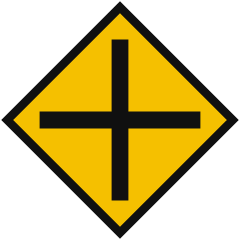
5. What should a driver expect a short distance beyond this sign?
Show answer
Answer C: Another road crossing the one being traveled
Traffic may enter or cross from either side at the intersection ahead, so the driver should ease off, cover the brake and check both approaches.
-
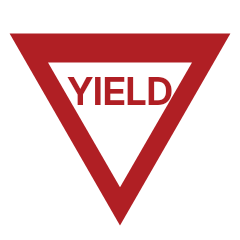
6. Apart from other vehicles, who else must a driver let go first at this sign?
Show answer
Answer A: Pedestrians and cyclists already in or entering the crossing
The duty to give way covers every road user who has the right of way at that point, including people walking or cycling across the driver's path.
-
7. The brake warning light stays on even though the parking brake is fully released. What does it indicate?
Show answer
Answer B: A possible brake system problem, so have the brakes checked promptly
The brake warning light also signals low brake fluid or a failure in one part of the hydraulic system. Do not ignore it, because braking may be reduced.
-
8. Why should you not rest your foot on the brake pedal as you drive?
Show answer
Answer D: The brake lights stay on and the drivers behind cannot read you
Resting on the pedal keeps the brake lights lit and wears the brakes, so following drivers stop believing your brake lights.
-
9. You have a green arrow to turn left. What still applies?
Show answer
Answer D: You must yield to any pedestrian or vehicle still inside the intersection
A green arrow protects your turn from conflicting traffic, but you must still let anyone already in the intersection get clear before you move.
-
10. You are leaving a freeway on an exit ramp posted with an advisory speed of 25 mph. Where should you slow to that speed?
Show answer
Answer A: In the deceleration lane, before you reach the curve of the ramp
Slowing belongs in the deceleration lane so you arrive at the curve already at the advisory speed and do not hold up traffic still in the through lanes.
-
11. An ambulance has just gone by and traffic starts to move again. Why should you wait a moment before pulling back out?
Show answer
Answer B: Another emergency vehicle may be following the first one
Emergency calls often bring several vehicles, so check that nothing else is coming before you rejoin the traffic lane.
-
12. A Utah driver is convicted of driving without insurance. What proof must then be filed, and for how long?
Show answer
Answer D: An SR22 policy for three years, along with a 40 dollar reinstatement fee
Utah requires future proof of financial responsibility in the form of an SR22 for three years, plus payment of a 40 dollar reinstatement fee.
-
13. A marked accessible space is signed as van accessible. What is different about it?
Show answer
Answer B: It has a wider aisle for a ramp or a lift to come out
The extra width beside the space is there so a side ramp or lift can deploy and a wheelchair can get clear of the vehicle.
-
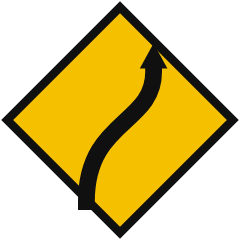
14. A driver holds a steady highway speed into the section this sign warns about. What is the most likely result?
Show answer
Answer B: The vehicle runs wide toward the outside and can cross into another lane or leave the pavement
Holding speed into a change of alignment asks the tires for more side grip than they can supply, so the vehicle runs wide and the driver is left with less room to correct.
-
15. Where should you be looking as you steer through a turn?
Show answer
Answer C: Toward the point on the new road where you want to end up
Drivers steer toward what they look at, so looking through the turn to where you want to go keeps the path smooth and accurate.
-
16. What is a good habit when you open the door on the traffic side of a parked car?
Show answer
Answer C: Use the hand farther from the door, which turns you to look back
Reaching across with the far hand rotates your body and brings the mirror and the road behind into view before the door moves.
-
17. Which effect appears as a drinker's blood alcohol level climbs well past the first drinks?
Show answer
Answer D: Loss of muscle control and steady steering
Higher levels of alcohol reach the parts of the brain that control movement, which shows up as clumsy steering, late braking and poor lane control.
-
18. Your car begins to lose power on a freeway and you must stop. Where should you try to bring it to a halt?
Show answer
Answer A: As far off the right side of the road as you can get, beyond the edge line
A disabled vehicle should be moved completely clear of the travel lanes, on the right, so that traffic can pass without changing course.
-
19. Your vehicle has antilock brakes. What should you never do in an emergency stop?
Show answer
Answer A: Pump the pedal up and down
The system already releases and reapplies the brakes many times a second. Pumping the pedal interrupts it and makes the stop longer.
-
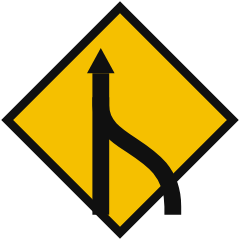
20. What does this sign warn a driver about?
Show answer
Answer A: Traffic from another roadway will enter the same lane ahead
Two traffic streams come together into one lane beyond this point, so drivers on both roadways have to adjust speed and spacing to fit together.
-
21. A driver reaching a stop sign is required to do what?
Show answer
Answer D: Come to a complete stop and then proceed only when it is safe
A stop sign requires a full stop before the stop line, crosswalk or intersection, after which the driver may go on once the way is clear.
-
22. The low sun is directly ahead and glare makes it hard to see. What should you do?
Show answer
Answer C: Slow down, use the sun visor or sunglasses, and increase following distance
Sun glare can hide pedestrians, brake lights and signals. Reducing speed and adding space gives you time to react to what you cannot yet see.
-
23. You are in a marked passing zone but a steady stream of oncoming traffic is coming toward you. What does the broken center line allow?
Show answer
Answer C: A pass only when the road is clear, so you have to stay behind
A passing zone marks where the sight distance is adequate, but it never gives permission to enter a lane that another vehicle is occupying.
-
24. You reach a stop-controlled intersection at the same time as a driver on your left, but that driver is already moving through the crossing. Who goes first?
Show answer
Answer C: The driver who is already inside the intersection
A vehicle already in the intersection has the right of way, and the rule about yielding to the right applies only before anyone has entered.
-
25. Why are tall vehicles such as SUVs and vans at extra risk in sudden steering maneuvers?
Show answer
Answer B: Their higher center of gravity makes them more likely to roll over
The higher a vehicle's mass sits, the more it leans in an abrupt turn, and a sharp swerve can tip it over. Smooth, gradual steering inputs are essential in tall vehicles.
-
26. Two roads come together at a shallow angle under a MERGE sign, with no yield line on either one. What is expected of you?
Show answer
Answer D: Adjust your speed and position so you blend smoothly into the other traffic
A merge means neither road ends at a stop; drivers adjust speed and position so that the two streams fit together without stopping.
-
27. How does Utah classify a texting while driving conviction?
Show answer
Answer A: A class C misdemeanor with a maximum fine of 100 dollars, rising to a class B misdemeanor with bodily injury or a prior offense
Utah treats texting while driving as a class C misdemeanor with a maximum 100 dollar fine, and upgrades it to a class B misdemeanor if bodily injury results or the driver has a prior conviction for the same offense.
-
28. The road ahead is broken up with potholes and rough patches. What should you do?
Show answer
Answer C: Slow down, since a hole hit at speed can wreck a tire or wheel
A lower speed cuts the impact on tires, wheels and suspension and gives you time to choose a line through the rough surface.
-
29. Rain is falling and the outside temperature reads close to 32 degrees Fahrenheit. Why is that dangerous?
Show answer
Answer A: The rain can freeze on contact and glaze the road with ice
Near freezing, rain landing on cold pavement can turn to a glaze of ice almost at once, so a road that looks merely wet may have no grip at all.
-
30. Why should you not leave the engine running when you walk away from your vehicle?
Show answer
Answer C: Because the vehicle can be stolen or can move on its own
An unattended running vehicle is an easy theft and, if the transmission slips or is knocked out of park, it can roll away with nobody at the wheel.
-
31. When is a driver at the highest risk of falling asleep at the wheel?
Show answer
Answer B: Late at night, early morning and mid afternoon
The body clock produces its deepest dips in alertness in the small hours and again in the middle of the afternoon, and crash records follow those dips.
-
32. You are stopped inside an intersection waiting for a gap to turn left. How should your front wheels be positioned?
Show answer
Answer C: Pointing straight ahead until you actually begin the turn
If your wheels are already turned left and another vehicle strikes you from behind, you would be pushed into oncoming traffic.
-
33. Someone appears seriously injured after a crash. What should you generally do?
Show answer
Answer C: Call for emergency help and avoid moving the person unless there is an immediate danger such as fire
Moving an injured person can worsen spinal or internal injuries, so summon trained help and leave the person in place unless staying there is more dangerous than moving.
-
34. You are in a passing zone that continues over the crest of a hill ahead. May you start a pass?
Show answer
Answer B: Only if you can finish it well before the crest
Beyond the crest you cannot see oncoming traffic, so any part of the pass that happens there is being made blind.
-
35. A truck passes you in heavy rain and its spray blanks out your windshield. What should you do?
Show answer
Answer B: Hold the wheel steady, ease off slightly and let the wipers clear it
The blackout lasts a second or two. Keeping your line and easing off is far safer than braking hard or steering blind toward the shoulder.
-
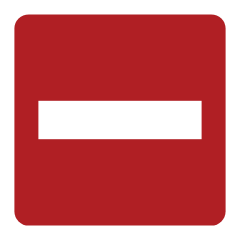
36. At which location is this sign normally installed?
Show answer
Answer D: Facing traffic that could turn into a one-way roadway or ramp against the flow
It is posted where a driver could otherwise enter a ramp or a one-way roadway from the wrong end, so it faces exactly the traffic that has to be kept out.
-
37. You are about to pass another vehicle at night with your high beams on. What should you do?
Show answer
Answer C: Switch to low beams as you come up behind it and while you are alongside
High beams shining into the mirrors of the vehicle ahead blind the very driver whose reaction you depend on during the pass.
-
38. A single solid white line separates two lanes running in the same direction. What is it telling drivers?
Show answer
Answer A: Changing lanes there is discouraged
A solid white lane line discourages lane changing, typically where merging or weaving would create a hazard.
-
39. A small plate under a stop sign reads CROSS TRAFFIC DOES NOT STOP. What is it telling you?
Show answer
Answer D: Traffic on the cross street is not required to stop at all
The plate warns that the other road is uncontrolled, so you must wait for a gap instead of expecting anyone to take turns with you.
-
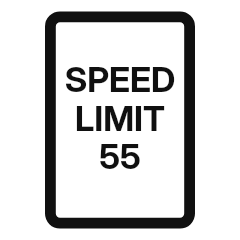
40. A driver passes this sign on an open road. Over what stretch does the figure it sets stay in force?
Show answer
Answer A: From the sign onward, in every lane, until another sign sets a different figure
The figure governs the road from the sign onward and binds every lane, and it stays in force until a later sign sets a different one.
-
41. You have stopped on an uphill grade close behind a large truck at a traffic signal. What is the risk?
Show answer
Answer B: The truck may roll back into you when it starts to move
Heavy vehicles can roll backward a short distance when the driver moves from the brake to the accelerator on a hill. Leave extra room when stopped behind a truck on a grade.
-
42. Your vehicle is stuck in deep snow and you run the engine for heat while waiting for help. What must you check?
Show answer
Answer C: That the exhaust pipe is clear of snow
Snow packed around the tailpipe pushes exhaust back into the cabin, and carbon monoxide can kill without warning. Clear the pipe and crack a window open.
-
43. A steady downward green arrow is displayed over a lane. What does it indicate?
Show answer
Answer C: The lane is open to traffic in your direction
A steady downward green arrow means the lane it points to is open to traffic traveling in your direction.
-
44. Which passenger is exempt from Utah's open container prohibition?
Show answer
Answer A: A passenger riding in the living quarters of a motor home or camper
Utah excuses a passenger in the living quarters of a motor home or camper, or on a compliant limousine or chartered bus, from the open container prohibition.
-
45. Your left-turn lane shows a flashing yellow arrow. What does that indication allow?
Show answer
Answer B: A left turn after yielding to oncoming traffic and to pedestrians
A flashing yellow arrow marks a permissive left turn: the movement is allowed, but oncoming vehicles and pedestrians keep the right-of-way.
-
46. How long should a young child ride in a rear-facing child seat?
Show answer
Answer D: Until the child outgrows the height or the weight limit of the seat
Rear facing is the safest position and should be kept until the child reaches the top height or weight allowed by the seat.
-
47. You are traveling beside a solid white lane line. What does it tell you?
Show answer
Answer B: Crossing it is discouraged or prohibited, so stay in your lane
A solid white line separates lanes going the same direction where lane changing is discouraged or prohibited, such as where a through lane meets a mandatory turn lane.
-
48. A person in a wheelchair is traveling in the roadway because the sidewalk is blocked by construction. What should you do?
Show answer
Answer B: Pass slowly with plenty of room, or wait
A blocked sidewalk leaves the person no choice but the road, and a chair cannot move aside quickly, so pass wide and slow or wait for room.
-
49. You enter a work zone at night where one lane is closed and a flagger is on duty. What is the safest approach?
Show answer
Answer A: Slow early, merge before the closure and be ready to stop
Merging early at a reduced speed keeps the queue orderly and leaves you room to stop for equipment, workers or traffic that has halted ahead.
-
50. Below a speed limit sign is a smaller panel with white numbers on a black background and the word NIGHT. What does it show?
Show answer
Answer D: The limit that applies after dark
A night speed limit panel sets a separate legal maximum for the hours of darkness, and its reversed colors mark it as the night figure.